Abstract
Healthcare is undergoing a profound transformation fueled by rapid technological breakthroughs, shifting demographics, and competition from new market entrants. In this environment, traditional board oversight is no longer sufficient. Boards must actively champion innovation—embracing strategic agility, diverse expertise, and a forward-looking, risk-tolerant mindset. This article explores why proactive board leadership is essential to shaping the future of healthcare.
Introduction
Healthcare has reached a pivotal moment. Technological disruption and market shifts are challenging long-standing models of care. Technology titans such as Amazon and Google are investing in patient services and health data infrastructure, while artificial intelligence is reshaping diagnostics, treatment planning, and administrative workflows. As one seasoned healthcare CEO notes, “Never in my 37 years have I witnessed the pace and intensity of change currently sweeping through healthcare.”
In this climate—marked by empowered consumers, growing competition, and digital acceleration—protecting the status quo is no longer a viable strategy. Boards must play a central role in steering organizations through this transformation.
To succeed, governance structures must evolve. Board members must embrace innovation as a strategic mandate, rethink composition and culture, and support emerging technologies and care models. This article explores the disruptive forces reshaping the sector, examines how boards can adapt, and highlights why leadership in innovation will define tomorrow’s healthcare winners.
The Disruptive Forces Reshaping Healthcare
The healthcare industry is experiencing a level of disruption that demands decisive, innovative governance. Many organizations still depend on outdated systems—“fax machines, manual workflows, and legacy processes”—leaving them vulnerable to more agile competitors.
Digital transformation is now a top strategic priority. According to a Deloitte survey, accelerated digital transformation ranked as the No. 1 issue for 2025, with nearly 70% of health executives identifying major investments in digital tools and platforms as essential. Virtual care, predictive analytics, automation, and AI-driven clinical decision support are becoming foundational components of modern care delivery.
Meanwhile, demographic pressures intensify the strain. Aging populations and rising chronic diseases stretch system capacity, while the World Health Organization forecasts a global shortage of 10 million healthcare workers by 2030.
Compounding these pressures, nontraditional players—Amazon, Walmart, Google, and others—are aggressively entering the market, introducing consumer-centric models and reshaping expectations around convenience, transparency, and value.
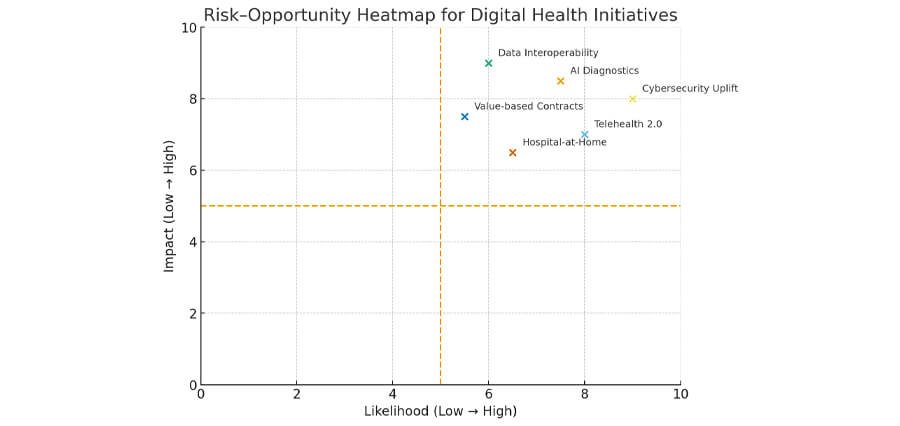
The result is unprecedented turbulence and opportunity, often visualized through models such as a Risk–Opportunity Heatmap (Figure 1), which helps boards distinguish high-impact digital initiatives from those requiring more cautious exploration.
Key Insight:
In a high-velocity, high-complexity environment, boards face unfamiliar risks and opportunities. Innovation can no longer be delegated downward; it must be governed from the top. The next section discusses how boards can rethink their roles to lead effectively through disruption.
The Evolving Role of Healthcare Boards
Historically, healthcare boards prioritized fiduciary oversight, compliance, and risk mitigation. Today, that remit must expand significantly. Experts argue that boards need to operate not only in an oversight capacity but also in strategic and generative modes—anticipating future trends, shaping organizational direction, and fostering continuous innovation.
Watson Advisors describes this shift as “future-focused governance”—a model in which boards balance risk management with the ability to identify opportunities, navigate uncertainty, and guide transformation. Figure 2 illustrates this innovation-oriented operating model.
To govern effectively in this era, boards must:
- Strengthen digital and clinical expertise to understand emerging technologies.
- Champion experimentation and calculated risk-taking.
- Promote a culture of innovation from the top down.
- Align strategy, investment, and talent with long-term transformation goals.